Wednesday, 3 February 2016

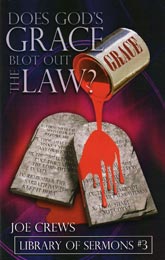
Does God's Grace Blot Out the Law?

By Joe Crews

The Authority of God’s Law


The devil, through sin, has just about wrecked this world of ours. We live in an age of rebellion against all restraint and law. Our nation stands aghast at the big-city gang defiance of social order and property rights, including the right to live. Murder, robbery, and personal assaults have become the trademark of both urban and suburban 20th-century life.

Each day as we read the newspaper it seems that the quality of life has edged downward a little bit further. At times we are tempted to believe that things can get no worse, and that conditions have hit rock bottom. Yet, the next day, even more violent, bizarre crimes are reported, and we simply shake our heads in disbelief. It is difficult to comprehend how a nation like America with its rich Christian heritage could ever depart so far from its founding principles. Even the non-Christian countries are not plagued with as much crime and overall violence as this so-called Christian nation. More crime is reported in Washington, D.C., in 24 hours than Moscow reports in a full year. No doubt the reporting methods are not the same, but it still presents an alarming picture.

The problem becomes more serious when we realize that lawlessness also reaches into the area of religion and affects millions who would never think of killing or raping. It is probable that the great majority of church members in America today carry few convictions against breaking at least one of the Ten Commandments. A very insidious doctrine has been developed in both Catholic and Protestant theology, which has tended to minimize the authority of God’s great moral law. It has led many to look lightly upon transgression and has made sin to appear unobjectionable. In fact, sin has lost its horror for multitudes and has become an acceptable mode of life for both youth and adults. Witness the current trends in lifestyle that support this view.

How many young men and women are living together without benefit of marriage! Yet they do not believe such living arrangements should be designated as sin. A large portion of shoplifters are professing Christians, and most of those who belong to churches believe that there is no sin whatsoever involved in violating the seventh-day Sabbath of the fourth commandment.

How can we explain this paradoxical situation among those who profess such high regard for the Bible, and such love for Christ? This question becomes more significant when we consider the historical position of Christianity toward the Ten-Commandment law. Almost all of the great denominations have officially placed themselves on record as supporting the authority of that law. Yet very subtle errors of interpretation have crept into the modern church, leading to the present state of confused loyalty toward the Ten Commandments. How earnestly we need to look at that law and study its relation to God’s grace and to salvation itself. Itis so easy to accept the popular clichés concerning law and grace without searching out the biblical facts by which we will finally be judged. We must find authoritative scriptural answers to questions like these: In what sense are Christians free from the law? What does it mean to be under the law? Does God’s grace nullify the Ten Commandments? Is a Christian justified in breaking any of the Ten Commandments because he is under grace? These are the questions we shall address ourselves to in this important study.

Condemned to Die


Let us push aside the rubbish of confusion that has obscured the truth about how men are saved. Multitudes have heard emotional discourses on sin and salvation, but they still do not understand the logic and reason that require a blood sacrifice.


Can you imagine the horror of standing before a judge and hearing the sentence of death pronounced against you? Probably not. But you have felt the driving guilt and fear when God’s Word stabs you with this sentence: “The wages of sin is death” (
Romans 6:23). Why fear and guilt? Because “all have sinned, and come short of the glory of God” (Romans 3:23).

The words are there and the meaning cannot be mistaken. The word “all” might just as well be spelled John Smith or Mary Jones or whatever your name happens to be. The shocking fact is that you are under the sentence of death! You have been found guilty before the law, and there is no court of appeal in the world that can reverse the sentence and find you not guilty. The fact is that you are guilty, just as guilty as sin. According to 1 John 3:4, “sin is the transgression of the law,” and you must plead guilty to breaking the law. Whose law did you break? Paul answers quickly, “I had not known sin, but by the law: for I had not known lust, except the law had said, Thou shalt not covet” (Romans 7:7). There it is! The great Ten-Commandment law is the one that was broken, and it demands death for the transgressor.

In desperation the sinner searches for a way to be justified in the sight of that broken law. How can the sentence of death be turned aside? Can man atone for his sins by obeying the commandments of God for the rest of his life? Back comes the answer in language that no one can misinterpret: “Therefore by the deeds of the law there shall no flesh be justified in his sight” (Romans 3:20).

Listen; there is a reason why works will not justify a soul. If a man is found guilty of stealing and is sentenced to ten years in jail, he may indeed justify himself by works. By serving the time of his sentence, the man may satisfy the claims of the law. He is considered perfectly justified and innocent because he has worked out his deliverance by fulfilling the sentence. In the same manner, a murderer may be justified by works if he serves the fifty years of his sentence. But suppose the sentence is death instead of fifty years? Can the prisoner then justify himself by works? Never! Even if he should work for one hundred years at hard labor, the law would still demanddeath. The truth is that “without shedding of blood is no remission. … So Christ was once offered to bear the sins of many” (Hebrews 9:22–28).

This is why works can never save the sinner. The penalty for sin is not ten years in prison or fifty years at hard labor. The sentence is death, and the law cannot be satisfied except by the shedding of blood. That unchangeable law with its unrelenting death sentence could no more be removed than the throne of God could be toppled. The guilt of the past cannot be erased by resolutions of good behavior in the future. The sinner finally is forced to confess that he owes something that he cannot pay. The law demands death and he cannot satisfy it without forfeiting his own life for eternity.

The Law Still Binding


Now we are brought to the question that has created confusion for multitudes of Christians: If the works of the law cannot save a person, is it therefore necessary to keep the law? Apparently this was a burning issue in the early church, because Paul asked the same question in Romans 6:1. “Shall we continue in sin, that grace may abound?” In other words, does grace give us a license to disobey the law of God? His answer is: “God forbid. How shall we, that are dead to sin, live any longer therein?” (verse 2).

How interesting it is that Christians in this age of relativism can invent their own definitions that condone lawbreaking. The Bible says sin is violating the Ten Commandments—the law which has been described as irrelevant and old-fashioned by many modern theologians. Don’t be deceived. Every one of those great moral precepts is just as timely and needful today as they were when God wrote them on the imperishable tables of stone. And nothing has ever happened to make them less binding than they were when God gave them. In fact, we are going to discover that Jesus came to magnify the law and to open up its spiritual application, making it more comprehensive than the legalistic Pharisees ever imagined. Under the distilling influence of Christ’s perfect life of obedience, we can see the spiritual details of law-keeping which are neither recognized nor made possible apart from Him.

God’s Law—A Mirror


At this point we must be very careful to designate also what the law cannot do. Even though it points out sin, it has no power to save from sin. There is no justifying, cleansing grace in it. All the works of all the laws would not be sufficient to save a single soul. Why? For the simple reason that we are saved by grace through faith, as a free gift. “Therefore by the deeds of the law there shall no flesh be justified in his sight: for by the law is the knowledge of sin” (
Romans 3:20).

Do not stumble over this crucial point. We cannot earn forgiveness by working hard to obey. No sinner can gain favor and acceptance with God because he keeps the law. The law was not made for the purpose of saving or justifying. It was made to show us our need of cleansing and to point us to the great source of cleansing, Jesus Christ, our Lord. The Bible speaks of the law as a mirror to show us what kind of persons we really are. “For if any be a hearer of the word, and not a doer, he is like unto a man beholding his natural face in a glass: For he beholdeth himself, and goeth his way, and straightway forgetteth what manner of man he was. But whoso looketh into the perfect law of liberty, and continueth therein, he being not a forgetful hearer, but a doer of the work, this man shall be blessed in his deed” (James 1:23–25).

It is obvious to all that a mirror cannot remove a spot from the face. Looking into the mirror all day, and even rubbing it over the face, will not provide any cleansing. Its work is to reveal the spot and to point the dirty one to the sink for actual cleansing. The law, in like manner, can only condemn the sinner by giving him knowledge of his condition and then pointing him to the cross for true cleansing. “For by grace are ye saved through faith; and that not of yourselves: it is the gift of God: Not of works, lest any man should boast” (Ephesians 2:8, 9). Paul further emphasizes this point in Galatians 2:16: “Knowing that a man is not justified by the works of the law, but by the faith of Jesus Christ … for by the works of the law shall no flesh be justified.”

Right here we must consider one of the most fallacious propositions ever set forth relating to the law. Countless sincere Christians have accepted the idea that the Old Testament encompasses the dispensation of works and that the New Testament provides for a dispensation of grace. Under this garbled plan people were saved by works in the Old Testament and by grace in the New Testament. This is simply not true. The Bible holds forth only one beautiful, perfect plan for anybody to be saved, and that is by grace through faith. Heaven will not be divided between those who got there by works and those who got there by faith. Every single soul among the redeemed will be a sinner saved by grace.

Those who entered into salvation in the Old Testament were those who trusted the merits of the blood of Jesus Christ, and they demonstrated their faith by bringing a lamb and slaying it. They looked forward in faith to the atoning death of Jesus. We look back in faith to the same death and are saved in exactly the same way. Be very certain that the entire redeemed host throughout eternity will be singing the same song of deliverance, exalting the Lamb slain from the foundations of the world.

The “New” Law of Christ


Some try to dispose of the Ten Commandments on the basis of the “new” commandments of love that Christ introduced. It is certainly true that Jesus laid down two great laws of love as a summary of all the law, but did He give the idea that these were new in point of time? The fact is that He was quoting directly from the Old Testament when He gave those new commandments. “And thou shalt love the Lord thy God with all thine heart, and with all thy soul, and with all thy might” (Deuteronomy 6:5). “Thou shalt love thy neighbour as thyself” (Leviticus 19:18). Certainly, those penetrating spiritual principles had been forgotten by the legalists of Christ’s day, and they were new to them in relation to their life and practice. But they were not intended by Jesus to take the place of the Ten Commandments.

When the lawyer asked Jesus which was the greatest commandment in the law, he received the answer: “Thou shalt love the Lord thy God with all thy heart, and with all thy soul, and with all thy mind. This is the first and great commandment. And the second is like unto it, Thou shalt love thy neighbour as thyself. On these two commandments hang all the law and the prophets” (Matthew 22:37–40).

Notice that these two love commandments simply summed up “all the law and the prophets.” They all hang upon these two principles of love. Christ was saying that love is the fulfilling of the law just as Paul repeated it later in Romans 13:10. If one loves Christ supremely with heart, soul, and mind, he will obey the first four commandments that have to do with our duty to God. He will not take God’s name in vain, worship other gods, etc. If one loves his neighbor as himself, he will obey the last six commandments that relate to our duty to our fellow men. He will not be able to steal from his neighbor, lie about him, etc. Love will lead to obeying or fulfilling all the law.

Not Under the Law


Often we hear this argument in an effort to belittle the law of God: “Well, since we are not under the law but under grace, we do not need to keep the Ten Commandments any longer.” Is this a valid point? The Bible certainly does say that we are not under the law, but does that imply that we are free from the obligation to obey it? The text is found in
Romans 6:14, 15. “For sin shall not have dominion over you: for ye are not under the law, but under grace. What then? shall we sin, because we are not under the law, but under grace? God forbid.”

How easily we could prevent confusion if we accepted exactly what the Bible says. Paul gives his own explanation of his statement. After stating that we are not under the law but under grace, he asks, “What then?” This simply means, “How are we to understand this?” Then notice his answer. In anticipation that some will construe his words to mean that you can break the law because you are under grace, he says, “Shall we sin (break the law) because we are not under the law but under grace? God forbid.” In the strongest possible language Paul states that being under grace does not give a license to break the law. Yet this is exactly what millions believe today, and they totally ignore Paul’s specific warning.

If being under grace does not exempt us from keeping the law, then what does Paul mean by saying that Christians are not under the law? He gives that answer in Romans 3:19. “Now we know that what things soever the law saith, it saith to them who are under the law: that every mouth may be stopped, and all the world may become guilty before God.” Here Paul equates being under the law with “being guilty before God.” In other words, those who are under the law are guilty of breaking it and are under the condemnation of it. This is why Christians are not under it. They are not breaking it—not guilty and condemned by it. Therefore, they are not under it, but are under the power of grace instead. Later in his argument, Paul points out that the power of grace is greater than the power of sin. This is why he states so emphatically, “For sin shall not have dominion over you: for ye are not under the law, but under grace.” Grace overrules the authority of sin, giving power to obey God’s law. This is the effective reason that we are not under the law’s guilt and condemnation and also why Paul states that we will not continue to sin.

Suppose a murderer has been sentenced to death in the electric chair. Waiting for the execution the man would truly be under the law in every sense of the word—under the guilt, under the condemnation, under the sentence of death, etc. Just before the execution date the governor reviews the condemned man’s case and decides to pardon him. In the light of extenuating circumstances the governor exercises his prerogative and sends a full pardon to the prisoner. Now he is no longer under the law but under grace. The law no longer condemns him. He is considered totally justified as far as the charges of the law are concerned. He is free to walk out of the prison and no policeman can lay hands upon him. But now that he is under grace and no longer under the law, can we say that he is free to break the law? Indeed not! In fact, that pardoned man will be doubly obligated to obey the law because he has found grace from the governor. In gratitude and love he will be very careful to honor the law of that state which granted him grace. Is that what the Bible says about pardoned sinners? “Do we then make void the law through faith? God forbid: yea, we establish the law” (Romans 3:31). Here is the most explicit answer to the entire problem. Paul asks if the law is nullified for us just because we have had faith in Christ’s saving grace. His answer is that the law is established and reinforced in the life of a grace-saved Christian.

The truth of this is so simple and obvious that it should require no repetition, but the devious reasoning of those who try to avoid obedience makes it necessary to press this point a bit further. Have you ever been stopped by a policeman for exceeding the speed limit? It is an embarrassing experience, especially if you know you are guilty. But suppose you really were hurrying to meet a valid emergency, and you pour out your convincing explanation to the police-man as he writes your ticket. Slowly he folds the ticket and tears it up. Then he says, “All right, I’m going to pardon you this time, but …” Now what do you think he means by that word “but”? Surely he means, “but I don’t want to ever catch you speeding again.” Does this pardon (grace) open the way for you to disobey the law? On the contrary, it adds compelling urgency to your decision not to disobey the law again. Why, then, should any true Christian try to rationalize his way out of obeying the law of God? “If ye love me,” Jesus said, “keep my commandments” (John 14:15).

Obedience—The Test of Love


Someone may bring up the objection that after the law has accomplished its purpose of pointing the sinner to Christ for cleansing, it will no longer be needed in the experience of the believer. Is that true? No, indeed. The Christian will always need the watchdog of the law to reveal any deviation from the true path and to point him back to the cleansing cross of Jesus. There will never be a time when that mirror of correction will not be needed in the progressive growth experience of the Christian.

Law and grace do not work in competition with each other but in perfect cooperation. The law points out sin, and grace saves from sin. The law is the will of God, and grace is the power to do the will of God. We do not obey the law in order to be saved but because we are saved. A beautiful text which combines the two in their true relationship is Revelation 14:12. “Here is the patience of the saints: here are they that keep the commandments of God, and the faith of Jesus.” What a perfect description of faith and works! And the combination is found in those who are “saints.”

The works of obedience are the real test of love. This is why they are so necessary in the experience of a true believer. “Faith without works is dead” (
James 2:20). No man ever won a fair maiden’s heart by words alone. Had there been no flowers, no acts of devotion, no gifts of love, most men would still be searching for a companion. Jesus said, “Not every one that saith unto me, Lord, Lord, shall enter into the kingdom of heaven; but he that doeth the will of my Father which is in heaven” (Matthew 7:21).

Words and profession are not enough. The true evidence is obedience. Today’s bumper stickers reflect a shallow concept of love. They say, “Smile if you love Jesus,” “Honk if you love Jesus”; but what did the Master Himself say? He said, “If ye love me, keep my commandments” (John 14:15). And that is exactly what most people don’t want to do. If love makes no demands beyond a smile or wave, then it is welcome; but if the lifestyle must be disturbed, the majority will reject it. Unfortunately, most people today are not looking for truth. They are looking for a smooth, easy, comfortable religion that will allow them to live the way they please and still give assurance of salvation. There is indeed no true religion that can do that for them.

One of the strongest texts in the Bible on this subject is found in 1 John 2:4. “He that saith, I know him, and keepeth not his commandments, is a liar, and the truth is not in him.” John could write that with such assurance because it is one of the most deeply established truths in the Bible. Jesus spoke of those who said, “Lord, Lord,” but did not do the will of the Father. Then He described many who would seek entrance to the kingdom claiming to be workers of miracles in the name of Christ. But He would sorrowfully have to say, “I never knew you: depart from me” (Matthew 7:21–23). You see, to know Christ is to love Him, and to love Him is to obey Him. The valid assumption of the Bible writers is very clear and simple: If one is not obeying Christ, he does not love Christ. And if he doesn’t love the Master, then he doesn’t know Him. John assured us, “And this is life eternal, that they might know thee the only true God, and Jesus Christ, whom thou hast sent” (John 17:3). Thus, we can see how knowing and loving and obeying are all tied closely together and are absolutely inseparable in the life of God’s faithful people. The beloved John summed it up in these words: “For this is the love of God, that we keep his commandments: and his commandments are not grievous” (1 John 5:3).

Is It Possible to Obey the Law?


Countless Christians have been taught that since the law is spiritual and we are carnal, no human being will ever be able in this life to meet the requirements of the perfect law. Is this true? Has it been given by God as a great idealistic, impossible goal toward which converted souls should struggle but never expect to attain? Is there some hidden reservation or secret meaning in the many commands to obey the ten great rules God wrote on stone? Did God mean what He said and say what He meant?

Many believe that only Christ could have obeyed that law and only because He had special powers that have not been made available to us. Certainly it is true that Jesus is the only One who lived without committing a single act of disobedience. His reason for living that perfect, victorious life is laid out in Romans 8:3, 4: “For what the law could not do, in that it was weak through the flesh, God sending his own Son in the likeness of sinful flesh, and for sin, condemned sin in the flesh: That the righteousness of the law might be fulfilled in us, who walk not after the flesh but after the Spirit.”

Do not miss the point that Jesus came to condemn sin by His perfect life in the flesh in order that “the righteousness of the law” might be fulfilled in us. What is that righteousness? The Greek word dikaima is used here, which means, literally, “the just requirement” of the law. This can only mean that Christ won His perfect victory in order to make the same victory available to us. Having conquered the devil, showing that in the flesh the law can be obeyed, Christ now offers to come into our hearts and share the victory with us. Only by His strength and indwelling power can the requirements of the law be fulfilled by anyone. Paul said, “I can do all things through Christ which strengtheneth me” (Philippians 4:13).

Not one soul can ever keep one of those Ten Commandments in human power alone, but all of them may be kept through the enabling strength of Jesus. He imputes His righteousness for cleansing and imparts His righteousness for victorious living. Christ came in a body of flesh like our own and depended wholly upon His Father in living His life to demonstrate the kind of victory which is possible for every soul who will likewise draw upon the Father’s grace.

Judged by the Law


Now, a final question about the subject of the law: How many of the Ten Commandments does one have to break in order to be guilty of sin? James says, “For whosoever shall keep the whole law, and yet offend in one point, he is guilty of all. For he that said, Do not commit adultery, said also, Do not kill. Now if thou commit no adultery, yet if thou kill, thou art become a transgressor of the law. So speak ye, and so do, as they that shall be judged by the law of liberty” (James 2:10–12).

Every individual will be judged at last by the mighty moral code of God’s law. To break one is to be guilty of sin. The Bible indicates that the Ten Commandments are like a chain with ten links. When one link is broken, the chain is broken. So it is with the law. Those who stand in the judgment will have to meet the acid test of the Ten Commandments. If a practicing thief should seek entrance into the kingdom, he would be rejected. This is why Paul says thieves will not inherit the heavenly city. Furthermore, the Bible specifically declares that liars, adulterers, idolaters, and covetous men will not be in the kingdom. Why? Because the Ten Commandments forbid those things, and men will be judged finally by that law. Not one person will be admitted into heaven who is willfully violating any one of the Ten Commandments, because breaking one is breaking all.

Someone might object that this is making works the basis of entering the kingdom. No. It is really making love the qualifying factor. Jesus said that the greatest commandment of all is to love God supremely. He also said, “If ye love me, keep my commandments” (
John 14:15). Those who practice any known sin are really confessing that they do not love God with all their heart, soul, and mind. So it is the lack of love that shuts them out—not the act of disobedience that exposes that lack. Only when love is motivating the obedience does it become acceptable to God. Any other work is man’s vain attempt to earn salvation and to deny the efficacy of Christ’s atoning sacrifice.

Ransomed for What?


A dramatic illustration of the law-grace doctrine is seen in the story of the slave auctions in old New Orleans long ago. Two planters were bidding for an old Negro slave who kept shouting his rebellion from the auction block. Finally, one of the planters won the bid and took the slave in his wagon back to the farm. Throughout the journey the defiant black man declared that he would not work for the new owner. When they arrived at the plantation, the planter dropped the shackles from the newly bought slave and said, “You are free to go. You are no longer a slave. I bought you in order to give you your liberty.”

According to the story, the old man fell at the feet of the planter and said, “Master, I’ll serve you forever.”

In like manner, we were all held in the bondage of sin, condemnation, and death. Christ then paid the price to secure our freedom from that hopeless slavery. Lovingly He tells us that the reason He made the sacrifice was to set us free. What should our response be?
Every ransomed child of God should fall at His feet and say, “Master, I love you for what you did for me. I’ll serve you the rest of my life.”

Think it through for a moment. Jesus had to die because the law had been broken. Sin demanded death. If the law could have been abrogated, the penalty of sin would have been set aside also. “For where no law is, there is no transgression” (Romans 4:15). So strong was the authority of that unchangeable law that God Himself could not abolish it—not even to save His own Son from death.

The old, old story of the two brothers is almost a perfect illustration of both law and grace in operation. The older brother was a judge. His younger brother was brought before him as a transgressor of the law. From all the evidence it was clear to all that he was guilty. The court was tense. Would the judge mete out justice in such a case? The judge looked at his brother and sternly declared him guilty. Then he stunned the court by imposing the maximum fine. But immediately he left the bench and threw his arms around his brother and said, “I had to do it because you are guilty. I know you cannot pay the fine, but I will pay it for you.”

The point of the story is dramatic in its impact. The brother was forgiven, but the penalty was not. It had to be paid. But by paying the maximum penalty, the judge not only did not abolish the law, but he greatly magnified it. He demonstrated that its binding claims could never be voided. In the same sense, God would not and could not abolish the law to save His beloved Son. It cost something to uphold the law and pay the maximum penalty. No one will ever know how much it cost the Son of God. But how thankful we should be that His love was as perfect as His justice. In His own body He bore the penalty, satisfied the law, and justified the transgressor.

Can’t you see that no greater demonstration could have been made to prove the permanence of the Ten Commandments? In the entire universe God could not have displayed a more convincing and irrefutable argument in favor of His law. Yet, in the face of this tremendous exhibition, misguided millions of poor, feeble men belittle the government of God by belittling His law. They seem not to understand that the law is only a reflection of His holiness and righteousness. To speak of its abolition is to border on treason against the divine government of heaven.

Look into that holy law right now for a divine revelation of what God wants your life to be. Confess that you have no strength to live up to that perfect standard. Then turn your eyes to the only One who has kept that law perfectly and who desires this very moment to enter your life with enabling power. He will fulfill the righteousness of the law—the just requirements of the law—in you, so that you can say with Paul, “Christ liveth in me: and the life which I now live in the flesh I live by the faith of the Son of God, who loved me, and gave himself for me” (Galatians 2:20).


Copyright 2015 by Amazing Facts Inc.

Free Book Library Archives »

Tuesday, 2 February 2016

Surprise Attack

Bible Study » Daily Devotional

AN AMAZING FACT:  On December 7, 1941, the Japanese attacked Pearl Harbor. The number of Americans who died was 2,388, the number wounded was 1,178, and the number of ships sunk or damaged was 21.
Each year Americans commemorate Pearl Harbor Day in memory of the thousands who were injured or killed when the Japanese made their surprise attack on the American naval base in Hawaii. It was a major turning point in World War II. Though the number who remember that day becomes fewer over the years, many can still hear President Franklin D. Roosevelt’s famous address, in which he says December 7, 1941, will be “a date which will live in infamy.” Is it still remembered? About 4,000 people visit Pearl Harbor each day, and 1.5 million visit the USS Arizona memorial each year.

The attack lasted only 110 minutes, from 7:55 AM until 9:45 AM. Plans for the assault had been in the works for almost one year. Its code name was “Operation Hawaii” and was later changed to “Operation Z.” The Japanese chose to attack on Sunday morning because they believed the Americans would be less alert and more relaxed. When the Japanese commander Mitsuo Fuchida called out “Tora! Tora! Tora! [Tiger! Tiger! Tiger!]” when flying over Pearl Harbor, it was a message to the entire Japanese Navy that they had caught the Americans totally by surprise.

The language of Joel when describing the “Day of the Lord” sounds familiar to those who watched the attack on Pearl Harbor. It is a grim comparison. “Blow the trumpet in Zion, And sound an alarm in My holy mountain! Let all the inhabitants of the land tremble; For the day of the Lord is coming, For it is at hand: A day of darkness and gloominess, A day of clouds and thick darkness. … A people come, great and strong. … A fire devours before them, And behind them a flame burns” (
Joel 2:1–3).

What a great and dreadful day that will be! For those who give their lives to Christ, however, it will not come as a surprise attack.
KEY BIBLE TEXTS
But the day of the Lord will come as a thief in the night; in the which the heavens shall pass away with a great noise, and the elements shall melt with fervent heat, the earth also and the works that are therein shall be burned up. 2 Peter 3:10
Copyright 2015 by Amazing Facts Inc. Site Map

~*~ LOVE IS IN THE AIR ~*~

"Not Only Would I Be Crazy 
To Leave You, 
But You Would Also Be Crazy
 To Leave Me!"
~*~*~*~*~*~*~*~*~*~*~*~*~*~*~*~*~*~
 Say This And More, With The
BEST Gifts 
For The LOVE Of Your Life 
From Our Store!

Our Books Will Enrich Your Life As A Couple
 ~*~*~*~*~*~*~*~*~*~*~*~*~*~*~*~
THE LANGUAGE OF LOVE


* Customers In Montego Bay, Jamaica

Call To Order For FREE Delivery

 SHALOME's BOOKS AND MAGAZINES

1(876) 547-7983 / 408-3151
(Call / WhatsApp)
 In Montego Bay, Jamaica
Call To Order For FREE Delivery
1(876) 547-7983 / 408-3151 (Call / WhatsApp)

SEX WITH LOVE


 Montego Bay, Jamaica
Call To Order For FREE Delivery
1(876) 547-7983 / 408-3151
(Vall / WhatsApp)

 
Montego Bay,Jamaica 

Call To Order


1(876) 547-7983 / 408-315

(Call / WhatsApp)

Invest In Your Relationship TODAY!


"I Am A Better Person 
With You By My Side"
"I Will Never Intentionally Hurt You!"
"Will You Be Mine For All Time?"

SPECIAL OFFER

Buy Two Books And Get A Bonus Book #FREE


LOVE IS IN THE AIR GIFT BOOKS


9 Bible Verses to Help When You’re Struggling with Guilt

We all make mistakes, and God’s Word says we all have sinned. No matter how you came to your situation or how long you’ve carried that distressing burden of guilt, God is ready with the solution. His arms are outstretched to you. Look at all He will do for you …

1. “For God did not send His Son into the world to condemn the world, but that the world through Him might be saved” (John 3:17). It’s not God’s purpose to condemn you; it’s His desire to take away your sins, to keep you from sin, and to save you through Jesus Christ.

2. “For He made Him who knew no sin to be sin for us, that we might become the righteousness of God in Him” (2 Corinthians 5:21). Jesus not only died for your sins, He took your sins upon Himself so He could give you His righteousness—His right standing with God.

3. “In Him we have redemption through His blood, the forgiveness of sins, according to the riches of His grace” (Ephesians 1:7). Through the sacrificial death of Christ, you are given forgiveness and salvation as a free gift.

4. “ ‘Come now, and let us reason together,’ ” says the Lord, ‘Though your sins are like scarlet, they shall be as white as snow; though they are red like crimson, they shall be as wool’ ” (Isaiah 1:18). God invites you to talk it over with Him, and He promises an outcome of great relief for you!
5. “If we confess our sins, He is faithful and just to forgive us our sins and to cleanse us from all unrighteousness” (1 John 1:9). All you need to do is tell God where you went wrong, that you are sorry, and He will take care of everything else and wash it away—transforming you into a new creature.

6. “For I will be merciful to their unrighteousness, and their sins and their lawless deeds I will remember no more” (
Hebrews 8:12).
In His great mercy, God erases your sin from His memory!

7. “As far as the east is from the west, so far has He removed our transgressions from us” (
Psalm 103:12).
It gives you a wonderful feeling of freedom to be separated from your sins and joined with God.

8. “There is therefore now no condemnation to those who are in Christ Jesus, who do not walk according to the flesh, but according to the Spirit” (Romans 8:1). If you follow Jesus and stay true to Him, you don’t have to worry about the judgment; your guilt is a thing of the past.

9. “Therefore, if anyone is in Christ, he is a new creation; old things have passed away; behold, all things have become new” (2 Corinthians 5:17). In addition to cleansing away all of your sins through the blood of the Lamb, God gives you a brand-new life—a new heart that will help keep you from sinning again.

Why not go to God right now and accept His wonderful gift of forgiveness through Jesus Christ? You have nothing to lose and an eternity to gain!


Copyright 2015 by Amazing Facts Inc. Site Map

An Open Door

~*~ Bible Study » Daily Devotional ~*~

 An Amazing Fact: Number 10 Downing Street is one of the most famous doors in the world. It attracts millions of visitors every year. One woman and 52 men have passed through the grand doors of Number 10 Downing Street as British Prime Minister. Sometimes they were met by violent riots, passionate protests, and even a few celebrities. One interesting fact about this door is that it can only be opened from the inside.


Another world-famous door is the Florence Baptistery in Florence, Italy. It took Lorenzo Ghiberti and two colleagues 27 years to produce the design that included 10 panels depicting scenes from the Old Testament. They are crafted from gilded bronze. Ghiberti’s use of the “principle of perspective” led Michelangelo to refer to these doors as fit to be the “Gates of Paradise.”

An ancient door famous among archaeologists is the Ishtar Gate from Babylon. Around 600 B.C. Nebuchadnezzar built this powerful blue-glazed brick gate. He emblazoned on the door the image of the dragon of Marduk. Also featured are golden lions and bulls. The gate is almost 50 feet high and 33 feet wide.

An interesting door in Rome is called the Holy Door of St. Peter’s Basilica, or the “Door of the Great Pardon,” which is sealed with a brick wall. Every 25 years the pope strikes the brick with a silver hammer and symbolically opens it. It remains open for the entire year. At the end of the year the brick wall is rebuilt. The Holy Door is meant to represent Jesus, as the gate to heaven and salvation.

The Bible describes Jesus standing before a door and knocking. “Behold, I stand at the door and knock. If anyone hears My voice and opens the door, I will come in to him and dine with him, and he with Me” (Revelation 3:20). Like 10 Downing Street, this door opens only from the inside. It is the door of your heart. You don’t have to wait 25 years for someone to open it. You can do so right now.

KEY BIBLE TEXTS
I know thy works: behold, I have set before thee an open door, and no man can shut it: for thou hast a little strength, and hast kept my word, and hast not denied my name.
Revelation 3:8

Copyright 2015 by Amazing Facts Inc. Site Map

God's Promises

Bible Study

 God's Word contains literally thousands of Bible promises waiting to be claimed in faith. Below we've listed just a few. It's our prayer that your faith and trust in our Heavenly Father will be increased as you seek Him to supply your every need. May you be blessed.

(NOTE: All Scripture references are from the KJV Bible)


And call upon me in the day of trouble: I will deliver thee, and thou shalt glorify me.


Is not this the fast that I have chosen? to loose the bands of wickedness, to undo the heavy burdens, and to let the oppressed go free, and that ye break every yoke?


The Spirit of the Lord GOD is upon me; because the LORD hath anointed me to preach good tidings unto the meek; he hath sent me to bind up the brokenhearted, to proclaim liberty to the captives, and the opening of the prison to them that are bound;


A new heart also will I give you, and a new spirit will I put within you: and I will take away the stony heart out of your flesh, and I will give you an heart of flesh. And I will put my spirit within you, and cause you to walk in my statutes, and ye shall keep my judgments, and do them.


If the Son therefore shall make you free, ye shall be free indeed.


There is therefore now no condemnation to them which are in Christ Jesus, who walk not after the flesh, but after the Spirit. For the law of the Spirit of life in Christ Jesus hath made me free from the law of sin and death.


There hath no temptation taken you but such as is common to man: but God is faithful, who will not suffer you to be tempted above that ye are able; but will with the temptation also make a way to escape, that ye may be able to bear it.


Therefore if any man be in Christ, he is a new creature: old things are passed away; behold, all things are become new.


This I say then, Walk in the Spirit, and ye shall not fulfil the lust of the flesh.


The angel of the LORD encampeth round about them that fear him, and delivereth them.


For thou hast been a shelter for me, and a strong tower from the enemy.


Because he hath set his love upon me, therefore will I deliver him: I will set him on high, because he hath known my name. He shall call upon me, and I will answer him: I will be with him in trouble; I will deliver him, and honour him.


And Jesus rebuked the devil; and he departed out of him: and the child was cured from that very hour. Then came the disciples to Jesus apart, and said, Why could not we cast him out? And Jesus said unto them, Because of your unbelief: for verily I say unto you, If ye have faith as a grain of mustard seed, ye shall say unto this mountain, Remove hence to yonder place; and it shall remove; and nothing shall be impossible unto you. Howbeit this kind goeth not out but by prayer and fasting.


And Jesus returned in the power of the Spirit into Galilee: and there went out a fame of him through all the region round about. And he taught in their synagogues, being glorified of all. And he came to Nazareth, where he had been brought up: and, as his custom was, he went into the synagogue on the sabbath day, and stood up for to read. And there was delivered unto him the book of the prophet Esaias. And when he had opened the book, he found the place where it was written, The Spirit of the Lord is upon me, because he hath anointed me to preach the gospel to the poor; he hath sent me to heal the brokenhearted, to preach deliverance to the captives, and recovering of sight to the blind, to set at liberty them that are bruised,


Submit yourselves therefore to God. Resist the devil, and he will flee from you.


And I heard a loud voice saying in heaven, Now is come salvation, and strength, and the kingdom of our God, and the power of his Christ: for the accuser of our brethren is cast down, which accused them before our God day and night. And they overcame him by the blood of the Lamb, and by the word of their testimony; and they loved not their lives unto the death.


The LORD also will be a refuge for the oppressed, a refuge in times of trouble. And they that know thy name will put their trust in thee: for thou, LORD, hast not forsaken them that seek thee.


The righteous cry, and the LORD heareth, and delivereth them out of all their troubles.


Then they cried unto the LORD in their trouble, and he saved them out of their distresses. He brought them out of darkness and the shadow of death, and brake their bands in sunder. Oh that men would praise the LORD for his goodness, and for his wonderful works to the children of men! For he hath broken the gates of brass, and cut the bars of iron in sunder.


Heaviness in the heart of man maketh it stoop: but a good word maketh it glad.


Fear thou not; for I am with thee: be not dismayed; for I am thy God: I will strengthen thee; yea, I will help thee; yea, I will uphold thee with the right hand of my righteousness.


For the mountains shall depart, and the hills be removed; but my kindness shall not depart from thee, neither shall the covenant of my peace be removed, saith the LORD that hath mercy on thee.


Remembering mine affliction and my misery, the wormwood and the gall. My soul hath them still in remembrance, and is humbled in me. This I recall to my mind, therefore have I hope. It is of the LORD's mercies that we are not consumed, because his compassions fail not. They are new every morning: great is thy faithfulness. The LORD is my portion, saith my soul; therefore will I hope in him. The LORD is good unto them that wait for him, to the soul that seeketh him.


Grace be to you and peace from God our Father, and from the Lord Jesus Christ. Blessed be God, even the Father of our Lord Jesus Christ, the Father of mercies, and the God of all comfort; Who comforteth us in all our tribulation, that we may be able to comfort them which are in any trouble, by the comfort wherewith we ourselves are comforted of God.


Honour thy father and thy mother: that thy days may be long upon the land which the LORD thy God giveth thee.


But the mercy of the LORD is from everlasting to everlasting upon them that fear him, and his righteousness unto children's children;


Train up a child in the way he should go: and when he is old, he will not depart from it.


The father of the righteous shall greatly rejoice: and he that begetteth a wise child shall have joy of him.


For I will pour water upon him that is thirsty, and floods upon the dry ground: I will pour my spirit upon thy seed, and my blessing upon thine offspring:


But thus saith the LORD, Even the captives of the mighty shall be taken away, and the prey of the terrible shall be delivered: for I will contend with him that contendeth with thee, and I will save thy children.


And he shall turn the heart of the fathers to the children, and the heart of the children to their fathers...


The LORD shall fight for you, and ye shall hold your peace.


And the LORD, he it is that doth go before thee; he will be with thee, he will not fail thee, neither forsake thee: fear not, neither be dismayed.


Have not I commanded thee? Be strong and of a good courage; be not afraid, neither be thou dismayed: for the LORD thy God is with thee whithersoever thou goest.


I will call upon the LORD, who is worthy to be praised: so shall I be saved from mine enemies.


Yea, though I walk through the valley of the shadow of death, I will fear no evil: for thou art with me; thy rod and thy staff they comfort me.


The LORD is my light and my salvation; whom shall I fear? the LORD is the strength of my life; of whom shall I be afraid?


The angel of the LORD encampeth round about them that fear him, and delivereth them.


For thou hast been a shelter for me, and a strong tower from the enemy.


For I the LORD thy God will hold thy right hand, saying unto thee, Fear not; I will help thee.


When thou passest through the waters, I will be with thee; and through the rivers, they shall not overflow thee: when thou walkest through the fire, thou shalt not be burned; neither shall the flame kindle upon thee.


Peace I leave with you, my peace I give unto you: not as the world giveth, give I unto you. Let not your heart be troubled, neither let it be afraid.


Turn you at my reproof: behold, I will pour out my spirit unto you, I will make known my words unto you.

For I will pour water upon him that is thirsty, and floods upon the dry ground: I will pour my spirit upon thy seed, and my blessing upon thine offspring:


And I say unto you, Ask, and it shall be given you; seek, and ye shall find; knock, and it shall be opened unto you. For every one that asketh receiveth; and he that seeketh findeth; and to him that knocketh it shall be opened. If a son shall ask bread of any of you that is a father, will he give him a stone? or if he ask a fish, will he for a fish give him a serpent? Or if he shall ask an egg, will he offer him a scorpion? If ye then, being evil, know how to give good gifts unto your children: how much more shall your heavenly Father give the Holy Spirit to them that ask him?


And whatsoever ye shall ask in my name, that will I do, that the Father may be glorified in the Son. If ye shall ask any thing in my name, I will do it. If ye love me, keep my commandments. And I will pray the Father, and he shall give you another Comforter, that he may abide with you for ever;


But ye shall receive power, after that the Holy Ghost is come upon you: and ye shall be witnesses unto me both in Jerusalem, and in all Judaea, and in Samaria, and unto the uttermost part of the earth.


And it shall come to pass in the last days, saith God, I will pour out of my Spirit upon all flesh: and your sons and your daughters shall prophesy, and your young men shall see visions, and your old men shall dream dreams: And on my servants and on my handmaidens I will pour out in those days of my Spirit; and they shall prophesy:


Then Peter said unto them, Repent, and be baptized every one of you in the name of Jesus Christ for the remission of sins, and ye shall receive the gift of the Holy Ghost. For the promise is unto you, and to your children, and to all that are afar off, even as many as the LORD our God shall call.


That he would grant you, according to the riches of his glory, to be strengthened with might by his Spirit in the inner man; That Christ may dwell in your hearts by faith; that ye, being rooted and grounded in love, May be able to comprehend with all saints what is the breadth, and length, and depth, and height; And to know the love of Christ, which passeth knowledge, that ye might be filled with all the fulness of God.


The LORD shall open unto thee his good treasure, the heaven to give the rain unto thy land in his season, and to bless all the work of thine hand: and thou shalt lend unto many nations, and thou shalt not borrow.


He becometh poor that dealeth with a slack hand: but the hand of the diligent maketh rich.


Wealth gotten by vanity shall be diminished: but he that gathereth by labour shall increase.


Bring ye all the tithes into the storehouse, that there may be meat in mine house, and prove me now herewith, saith the LORD of hosts, if I will not open you the windows of heaven, and pour you out a blessing, that there shall not be room enough to receive it.


Therefore take no thought, saying, What shall we eat? or, What shall we drink? or, Wherewithal shall we be clothed? (For after all these things do the Gentiles seek:) for your heavenly Father knoweth that ye have need of all these things. But seek ye first the kingdom of God, and his righteousness; and all these things shall be added unto you.


But my God shall supply all your need according to his riches in glory by Christ Jesus.


If my people, which are called by my name, shall humble themselves, and pray, and seek my face, and turn from their wicked ways; then will I hear from heaven, and will forgive their sin, and will heal their land.


Thou hast forgiven the iniquity of thy people, thou hast covered all their sin. Selah.


For thou, Lord, art good, and ready to forgive; and plenteous in mercy unto all them that call upon thee.


And when ye stand praying, forgive, if ye have ought against any: that your Father also which is in heaven may forgive you your trespasses.


And be ye kind one to another, tenderhearted, forgiving one another, even as God for Christ's sake hath forgiven you.


If we confess our sins, he is faithful and just to forgive us our sins, and to cleanse us from all unrighteousness.


And, behold, I am with thee, and will keep thee in all places whither thou goest, and will bring thee again into this land; for I will not leave thee, until I have done that which I have spoken to thee of.


What man is he that feareth the LORD? him shall he teach in the way that he shall choose.


I will instruct thee and teach thee in the way which thou shalt go: I will guide thee with mine eye.


Trust in the LORD with all thine heart; and lean not unto thine own understanding. In all thy ways acknowledge him, and he shall direct thy paths.


And if thou draw out thy soul to the hungry, and satisfy the afflicted soul; then shall thy light rise in obscurity, and thy darkness be as the noon day: And the LORD shall guide thee continually, and satisfy thy soul in drought, and make fat thy bones: and thou shalt be like a watered garden, and like a spring of water, whose waters fail not.


And it shall come to pass, that before they call, I will answer; and while they are yet speaking, I will hear.


Call unto me, and I will answer thee, and shew thee great and mighty things, which thou knowest not.


Howbeit when he, the Spirit of truth, is come, he will guide you into all truth: for he shall not speak of himself; but whatsoever he shall hear, that shall he speak: and he will shew you things to come.


If any of you lack wisdom, let him ask of God, that giveth to all men liberally, and upbraideth not; and it shall be given him.


And said, If thou wilt diligently hearken to the voice of the LORD thy God, and wilt do that which is right in his sight, and wilt give ear to his commandments, and keep all his statutes, I will put none of these diseases upon thee, which I have brought upon the Egyptians: for I am the LORD that healeth thee.


Bless the LORD, O my soul, and forget not all his benefits: Who forgiveth all thine iniquities; who healeth all thy diseases; Who redeemeth thy life from destruction; who crowneth thee with lovingkindness and tender mercies; Who satisfieth thy mouth with good things; so that thy youth is renewed like the eagle's.


Be not wise in thine own eyes: fear the LORD, and depart from evil. It shall be health to thy navel, and marrow to thy bones.


But they that wait upon the LORD shall renew their strength; they shall mount up with wings as eagles; they shall run, and not be weary; and they shall walk, and not faint.


He is despised and rejected of men; a man of sorrows, and acquainted with grief: and we hid as it were our faces from him; he was despised, and we esteemed him not. Surely he hath borne our griefs, and carried our sorrows: yet we did esteem him stricken, smitten of God, and afflicted. But he was wounded for our transgressions, he was bruised for our iniquities: the chastisement of our peace was upon him; and with his stripes we are healed.


Heal me, O LORD, and I shall be healed; save me, and I shall be saved: for thou art my praise.


For I will restore health unto thee, and I will heal thee of thy wounds, saith the LORD...


But unto you that fear my name shall the Sun of righteousness arise with healing in his wings; and ye shall go forth, and grow up as calves of the stall.


Is any sick among you? let him call for the elders of the church; and let them pray over him, anointing him with oil in the name of the Lord: And the prayer of faith shall save the sick, and the Lord shall raise him up; and if he hath committed sins, they shall be forgiven him.


And the LORD God said, It is not good that the man should be alone; I will make him an help meet for him.


Delight thyself also in the LORD: and he shall give thee the desires of thine heart.


God setteth the solitary in families...


Whoso findeth a wife findeth a good thing, and obtaineth favour of the LORD.


For thy Maker is thine husband; the LORD of hosts is his name; and thy Redeemer the Holy One of Israel; The God of the whole earth shall he be called.


For I know the thoughts that I think toward you, saith the LORD, thoughts of peace, and not of evil, to give you an expected end.


And this is the confidence that we have in him, that, if we ask any thing according to his will, he heareth us:


I have blotted out, as a thick cloud, thy transgressions, and, as a cloud, thy sins: return unto me; for I have redeemed thee.


And I will deliver thee out of the hand of the wicked, and I will redeem thee out of the hand of the terrible.


For God so loved the world, that he gave his only begotten Son, that whosoever believeth in him should not perish, but have everlasting life.


He that believeth on the Son hath everlasting life: and he that believeth not the Son shall not see life; but the wrath of God abideth on him.


For the wages of sin is death; but the gift of God is eternal life through Jesus Christ our Lord.


For I am persuaded, that neither death, nor life, nor angels, nor principalities, nor powers, nor things present, nor things to come, Nor height, nor depth, nor any other creature, shall be able to separate us from the love of God, which is in Christ Jesus our Lord.


That if thou shalt confess with thy mouth the Lord Jesus, and shalt believe in thine heart that God hath raised him from the dead, thou shalt be saved. For with the heart man believeth unto righteousness; and with the mouth confession is made unto salvation.


To the praise of the glory of his grace, wherein he hath made us accepted in the beloved. In whom we have redemption through his blood, the forgiveness of sins, according to the riches of his grace;


Let your conversation be without covetousness; and be content with such things as ye have: for he hath said, I will never leave thee, nor forsake thee.


If we confess our sins, he is faithful and just to forgive us our sins, and to cleanse us from all unrighteousness.


He that overcometh, the same shall be clothed in white raiment; and I will not blot out his name out of the book of life, but I will confess his name before my Father, and before his angels.


Behold, I stand at the door, and knock: if any man hear my voice, and open the door, I will come in to him, and will sup with him, and he with me.


Have not I commanded thee? Be strong and of a good courage; be not afraid, neither be thou dismayed: for the LORD thy God is with thee whithersoever thou goest.


Wait on the LORD: be of good courage, and he shall strengthen thine heart: wait, I say, on the LORD.


He giveth power to the faint; and to them that have no might he increaseth strength.


No weapon that is formed against thee shall prosper; and every tongue that shall rise against thee in judgment thou shalt condemn. This is the heritage of the servants of the LORD, and their righteousness is of me, saith the LORD.


A new heart also will I give you, and a new spirit will I put within you: and I will take away the stony heart out of your flesh, and I will give you an heart of flesh. And I will put my spirit within you, and cause you to walk in my statutes, and ye shall keep my judgments, and do them.


For which cause we faint not; but though our outward man perish, yet the inward man is renewed day by day. For our light affliction, which is but for a moment, worketh for us a far more exceeding and eternal weight of glory; While we look not at the things which are seen, but at the things which are not seen: for the things which are seen are temporal; but the things which are not seen are eternal.


And let us not be weary in well doing: for in due season we shall reap, if we faint not.


I can do all things through Christ which strengtheneth me.
 
 Copyright 2015 by Amazing Facts Inc.
Site Map

Monday, 1 February 2016

Persevere

Bible Study » Daily Devotional

AN AMAZING FACT:  After being drafted, Desmond Doss’ refusal to bear arms gave his commanders fits, and his fellow soldiers often used the meek misfit as a punching bag. He believed his Christian faith forbade the taking of lives and promoted their saving. He always kept his Bible close by but refused to carry a weapon at his own peril. Yet as an infantry medic during World War II, Doss did as much as any great warrior to save the lives of his fellow men.
During a bloody assault in Okinawa in April 1945, private first-class Doss exhibited magnificent fortitude and unflinching bravery in the face of deadly conditions. He retrieved 75 wounded men off a rocky cliff while under constant enemy fire. Doss believed this feat was made possible only by the guiding and protective hand of God. Doss received many wounds during that battle, but he always tended to others before himself.

His reputation as a soldier propelled his name as a symbol for outstanding faith. While seriously wounded after jumping on a grenade to protect his fellow men, Doss dragged himself through the battlefield to treat wounded soldiers until he was rescued. Doss later discovered he’d lost his Bible during the conflict. However, the respect of his fellow soldiers had grown so profound that they searched the battlefield until they found the beloved Book of the private they had all once mocked.

For his heroic efforts and bravery, Doss received this country’s highest military honor. On Columbus Day in 1945, President Truman placed the Congressional Medal of Honor around Doss’ neck and said, “This is a greater honor for me than being president.” Doss is the only conscientious objector ever to receive the award.

Christ, in the same way, honors the church of Philadelphia. “I know your works. See, I have set before you an open door, and no one can shut it; for you have a little strength, have kept My word, and have not denied My name” (
Revelation 3:8). And, “Because you have kept My command to persevere, I also will keep you from the hour of trial” (v. 10). Praise God for protection to those who persevere in His name.
 
KEY BIBLE TEXTS
 
And not only so, but we glory in tribulations also: knowing that tribulation worketh patience; Romans 5:3 
 
Copyright 2015 by Amazing Facts Inc.